The story, in brief
Two children, whose stepmother has convinced their father the family can't afford to feed them, are led into the forest and abandoned. Starving, they find a house built of bread and sugar and begin to eat it, only to discover it belongs to a witch who fattens children up to eat them. Gretel outwits the witch, pushing her into her own oven, and the children escape home with the witch's treasure.
A story that starts with hunger, not magic
Most fairy tales open with a wish, a curse, or a stranger arriving at a door. Hansel and Gretel opens with arithmetic: a poor woodcutter and his wife don't have enough food for four people, and they decide, twice, after the children find their way home the first time, that the solution is to have two fewer mouths to feed. There is no villain yet in the first scene. There is only scarcity, and a choice made under its pressure that the story never fully forgives.
Historians studying medieval Europe have long noted how closely this setup matches documented famine behavior, particularly the Great Famine of 1315-1317, when crop failures across northern Europe led to widespread starvation, and some surviving records describe parents abandoning children they could no longer feed. The tale almost certainly predates any single written record by generations of oral retelling, but the famine gives the story's opening a weight that reads less like fantasy and more like memory passed down past the point anyone could name the year it happened.
The house that should have been safety
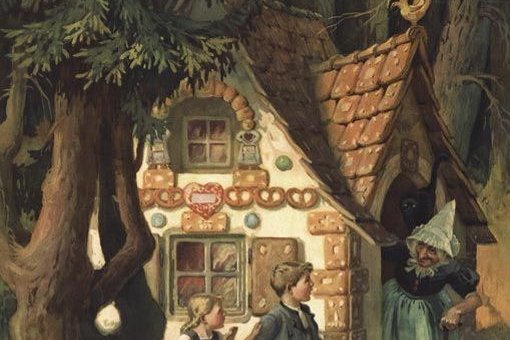
When the children finally find food after days of starving in the forest, it arrives in the most literal form possible: walls made of bread, a roof of cake, windows of clear sugar. For children already pushed to the edge of survival, a house built entirely of food isn't just a fantasy image; it's the exact opposite of the scarcity that drove the whole story. That's precisely why it's a trap. The witch inside doesn't lure them with anything they don't already desperately need; she simply waits for hunger to do the work.
This is one of the tightest pieces of symbolic construction in the Grimm collection: the story's central threat is built from the same material as its central problem. Fattening Hansel in a cage to eat him later is a grotesque, literal version of what the opening famine threatened to do to both children anyway, just transferred from circumstance to intention.
Gretel, not Hansel, ends the story
Despite the title ordering, it's Gretel who outwits the witch at the climax, tricking her into checking the oven herself and shutting her inside it. Hansel spends much of the story's second half caged, feeding the witch a chicken bone instead of his finger so she can't tell he's fattening up. The rescue is entirely Gretel's doing, which has made the tale a frequent subject of discussion among folklorists studying how often fairy tale heroines, often remembered as passive, are actually the ones who resolve the plot.
A mother revised into a stepmother
One of the more documented editorial choices in the Grimm Brothers' own history concerns who sends the children away. Their earliest collected version has the children's biological mother proposing the abandonment, with the father reluctant. By their later editions (the versions most readers encounter today), the mother has become a stepmother, a change scholars generally read as a softening aimed at a readership increasingly treating the collection as a children's book rather than a record of oral folklore for a general adult audience. The father, notably, is given more guilt and hesitation in later texts than he had originally, while the blame for the plan itself is shifted off the children's actual parent.
Why the tale still unsettles
Hansel and Gretel survives partly because, unlike many fairy tales, its ending doesn't fully undo its opening wound. The children kill the witch and escape with her treasure, but nothing restores what already happened: they were sent away, twice, by people who were supposed to protect them. The story resolves its external danger without pretending the original betrayal never occurred, which is part of why it has remained one of the more psychologically unsettling entries in the Grimm canon, even in its gentlest modern retellings.